
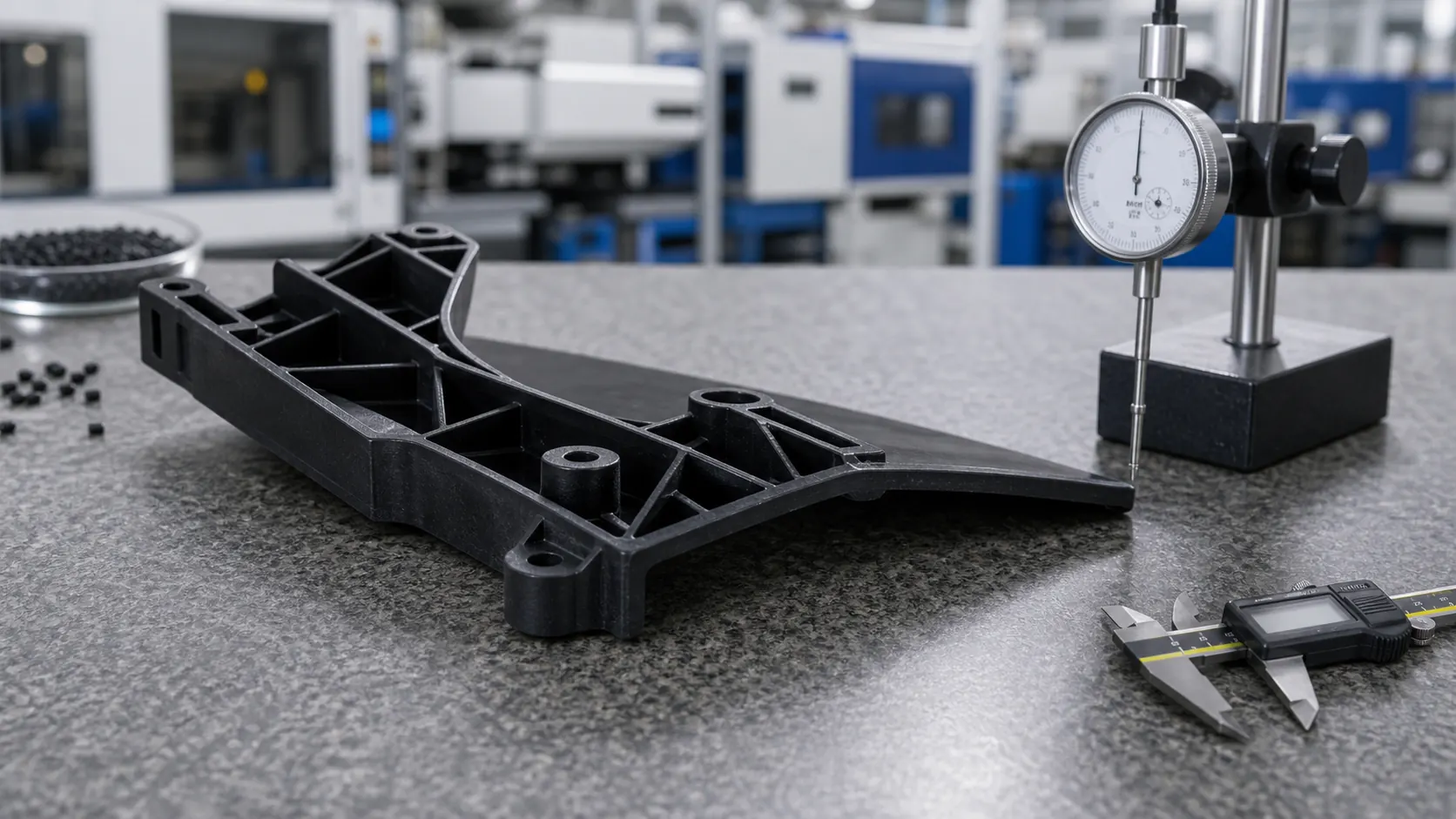
Many engineers encounter the same frustrating situation. The tensile strength meets specification, the stiffness is sufficient, the mold fills properly, and the part looks acceptable at the machine. Yet after demolding, the component refuses to stay flat. Hours or days later, the deformation becomes even worse.
This is especially common in PA6 GF30, PA66 GF30, long glass fiber reinforced nylon, electronic housings, power tool components, and automotive plastic parts. The problem is not simply that the material is weak. In many cases, the part is warping because the reinforced material is mechanically strong but dimensionally unbalanced.
Table of Contents
- 1. Why Glass Fiber Reinforced Nylon Is Prone to Warpage
- 2. What Is Warpage?
- 3. 1. Fiber Orientation and Anisotropic Shrinkage
- 4. 2. Uneven Mold Cooling
- 5. 3. Post-Crystallization and Moisture Absorption
- 6. 4. Injection Molding Parameters
- 7. How to Reduce Warpage
- 8. How to Verify Dimensional Stability
- 9. Engineering FAQ
Why Are Glass Fiber Reinforced Nylon Parts So Prone to Warpage?
Many manufacturers assume that a stronger material should naturally produce a more dimensionally stable part. In reality, the opposite can happen. As glass fiber content increases, the risk of warpage can increase if fiber orientation and shrinkage direction are not managed.
To solve warpage, it is necessary to understand what happens inside the material during filling, cooling, ejection, storage, and moisture conditioning. For glass filled nylon, warpage is rarely caused by one parameter alone. It is the result of accumulated stress imbalance across the entire manufacturing system.
What Is Warpage in Glass Fiber Reinforced Nylon?
Warpage is unwanted deformation caused by uneven shrinkage or stress release in different regions of a molded part. Unlike sink marks or flash, warpage is usually a three-dimensional dimensional stability problem rather than a local appearance defect.
A part may gradually distort during:
- Cooling after ejection.
- Warehouse storage.
- Assembly and fixture loading.
- Transportation.
- Humidity or temperature exposure.
For automotive and electronics applications, small deviations can create gap inconsistency, noise and vibration issues, reduced sealing performance, and assembly interference.
1. Fiber Orientation Creates Anisotropic Shrinkage
Fiber orientation is often the most important cause of warpage in glass fiber reinforced nylon. During injection molding, glass fibers align with the melt flow direction. Once the fibers align, the material no longer shrinks equally in all directions.
Along the Fiber Direction
Glass fibers restrict polymer contraction. Shrinkage remains relatively low and stiffness is high.
Perpendicular to Fiber Direction
The reinforcing effect is weaker. Shrinkage becomes higher, creating bending, twisting, or bowing.
This directional shrinkage is called anisotropic shrinkage. In a flat automotive panel, if most fibers align along the length of the part, lengthwise shrinkage stays low while widthwise shrinkage becomes larger. The result is bending or twisting even when the mold itself is correct.
2. Uneven Mold Cooling Creates Differential Shrinkage
Mold cooling is not only about reducing cycle time. Its more important function is keeping the part temperature field uniform enough that shrinkage occurs in a controlled way. If one region freezes early while another continues shrinking, internal stress gradients are created.
Cooling-related warpage commonly appears around:
- Thick-to-thin transitions.
- Rib concentration areas.
- Screw bosses and mounting posts.
- Large flat surfaces.
- Long flow paths with uneven temperature history.
In large flat parts, even a small temperature difference can create visible distortion. For this reason, cooling channel layout, distance to cavity surface, baffle design, and hot spot control must be reviewed together with the material shrinkage data.
3. Post-Crystallization and Moisture Absorption
Nylon behaves differently from ABS or PC/ABS because it is semi-crystalline and hygroscopic. The material structure can keep changing after molding.
Secondary Crystallization
After ejection, nylon may continue crystallizing. As crystallinity increases, density increases and volume changes. This can create delayed warpage that appears hours or days after the part looked stable.
Moisture Absorption
Nylon naturally absorbs moisture from the surrounding environment. As water molecules enter the polymer structure, molecular spacing changes, internal stress redistributes, and dimensions shift. This is especially significant for PA6, PA6 GF30, and PA66 GF30 in humid environments.
For a deeper explanation of nylon moisture behavior, see our guide on nylon moisture absorption and dimensional instability.
4. Improper Injection Molding Parameters
Processing conditions directly affect fiber orientation, density distribution, and residual stress. Even with a good mold and material, poor parameter settings can create severe dimensional instability.
Excessive Injection Speed
High speed can create strong fiber alignment, uneven orientation distribution, and higher molecular stress. This increases directional shrinkage differences.
Improper Packing Pressure
Excessive packing can lock in residual stress. Insufficient packing can create density variation. Both conditions may lead to distortion after ejection.
Inconsistent Mold Temperature
Low or unstable mold temperature can produce rapid skin solidification, larger thermal gradients, and higher internal stress. For engineering nylons, mold temperature control is often more important than melt temperature adjustment.
How to Reduce Warpage in Glass Fiber Reinforced Nylon Parts
There is rarely a single fix. Successful warpage control requires coordinated optimization of material, mold design, cooling, and processing.
Material Optimization
- Use low-warpage nylon compounds where flatness is critical.
- Consider hybrid reinforcement systems that combine glass fiber with mineral fillers.
- Balance glass fiber content against anisotropic shrinkage risk.
- Use sealed packaging and consistent drying conditions before molding.
Mold Design Optimization
- Place gates to distribute fiber orientation as evenly as possible.
- Minimize wall thickness variation and abrupt thick-to-thin transitions.
- Improve cooling balance around ribs, bosses, and large flat regions.
- Review mold rigidity where large projected area or high cavity pressure is involved.
Process Optimization
- Use multi-stage injection to reduce aggressive fiber alignment.
- Optimize packing pressure for density control without excessive residual stress.
- Maintain stable mold temperature across production shifts.
- Verify moisture content and drying history before each production run.
How to Verify Dimensional Stability
A nylon part is not dimensionally stable just because it looks flat immediately after ejection. Warpage validation should include time, humidity, and assembly conditions.
| Initial flatness check | Measure immediately after molding to establish the starting condition. |
|---|---|
| 24-72 hour storage check | Confirm delayed warpage from stress release or secondary crystallization. |
| Humidity exposure | Evaluate moisture-induced dimensional drift for PA6 and PA66 parts. |
| Assembly fixture test | Confirm that real mounting constraints do not amplify distortion. |
| Material lot comparison | Check whether glass fiber content, MFI, or drying variation changes flatness. |
Recommended Material Solutions
YicaiPlas supports customized nylon and engineering plastic compounds for applications that require stiffness, dimensional control, and reliable molding performance.
Engineering FAQ
Why do PA6 GF30 and PA66 GF30 parts warp after injection molding?
The main causes are fiber orientation, anisotropic shrinkage, uneven cooling, post-crystallization, moisture absorption, and residual molding stress. These factors can continue affecting dimensions after demolding.
Does higher glass fiber content always improve dimensional stability?
No. Higher glass fiber content increases stiffness and lowers shrinkage along the fiber direction, but it can also increase anisotropic shrinkage and warpage if fiber orientation is not controlled.
Why does nylon warpage sometimes appear hours or days later?
Nylon is semi-crystalline and hygroscopic. Secondary crystallization and moisture absorption can continue after molding, changing volume, stress distribution, and part dimensions over time.
How can mold design reduce warpage in glass filled nylon parts?
Balanced gate location, uniform wall thickness, sufficient mold rigidity, and uniform cooling are critical. Cooling channels should minimize hot spots around ribs, bosses, and thick-to-thin transitions.
What material solutions can reduce nylon warpage?
Low-warpage nylon compounds, hybrid glass/mineral reinforcement systems, optimized glass fiber content, and moisture-controlled packaging can reduce anisotropic shrinkage and improve dimensional stability.
Related Technical Articles
Glass Fiber Exposure in Injection Molding
A related guide on floating fiber, surface finish, fiber wetting, and low-floating-fiber formulations.
Nylon Moisture Absorption and Dimensional Change
Why nylon parts warp, soften, and drift in size after molding due to moisture absorption and conditioning.
Injection Molding Flash Troubleshooting
System-level analysis of flash defects involving mold condition, pressure, clamp force, and material behavior.
Part Sticking and Mold Release Problems
How demolding force, shrinkage gripping, friction, draft angle, and material selection affect mold release.
Related Material Solutions
Glass Fiber Reinforced Plastics
Custom PA6, PA66, PP, and hybrid reinforced compounds for stiffness and dimensional control.
High Impact Plastic Solutions
Reinforced and impact modified engineering plastics for structural molded components.
Ask an Engineer
Discuss material grade, fiber content, mold design, and warpage validation with our technical team.
Need Help Reducing Warpage in Glass Filled Nylon Parts?
YicaiPlas provides customized PA6 GF, PA66 GF, low-warpage nylon compounds, and processing support for automotive, electronics, and industrial injection molding applications.
Contact Our Engineering Team