
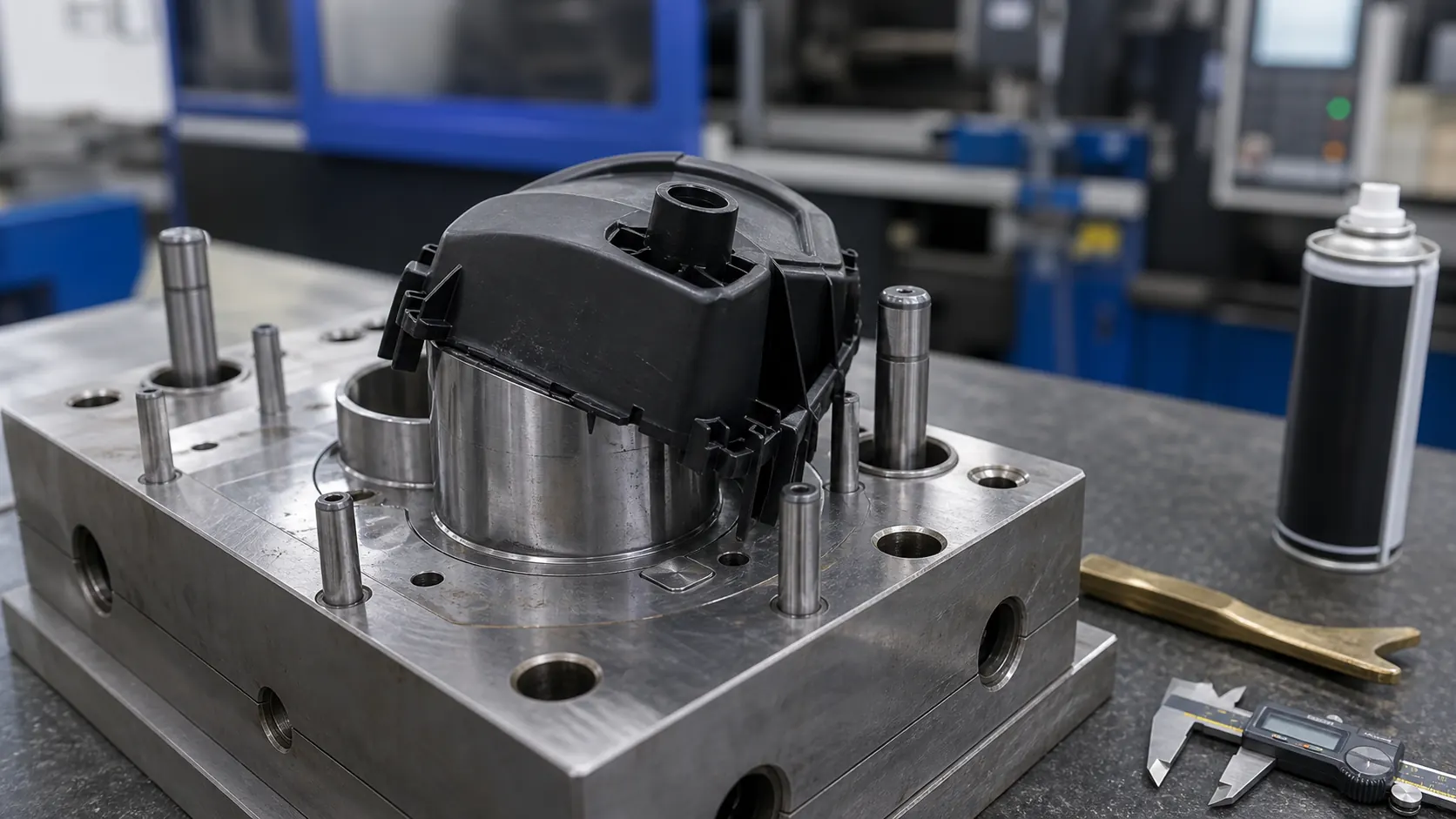
Few production issues create more frustration in an injection molding workshop than a part stuck inside the mold. Operators may increase ejector force, apply mold release spray, extend cooling time, or force ejection. Sometimes these methods work temporarily. Most of the time, they only treat the symptom.
A severe sticking incident can stop an entire production line, damage expensive mold components, and create hours or days of downtime. The real question is not how to pull the part out once. The real question is why the molded part refuses to release in the first place.
Table of Contents
Why Is Part Sticking One of the Most Expensive Injection Molding Problems?
Mold sticking directly attacks production efficiency. A small release problem can quickly become a mold repair issue, a shipment delay, or a customer complaint. For high-volume programs, even a short stoppage can cost more than the material used in the entire batch.
This is why sticking should be analyzed like other high-impact injection molding defects such as recurring flash defects and glass fiber reinforced nylon warpage. The best factories do not rely on emergency fixes. They design the mold, material, and process window so demolding remains stable.
What Is Mold Sticking?
Mold sticking occurs when the force holding the part onto the mold core or cavity surface exceeds the force generated by the ejection system. After cooling, plastic parts shrink around mold cores and must slide along steel surfaces during ejection.
Shrinkage Gripping Force
As the plastic cools, it contracts around the mold core. The stronger the shrinkage grip, the harder the part is to release.
Friction Force
The part must slide against the mold surface. Roughness, scratches, corrosion, texture, and poor polishing direction all increase friction.
1. Insufficient Draft Angle
Insufficient draft angle is the most common cause of part sticking in mold. Many product designs prioritize appearance, vertical walls, or compact geometry while neglecting release requirements. After cooling, the molded part tightly grips the core and release force rises sharply.
| Textured surfaces | 1-2 degrees minimum |
|---|---|
| Polished surfaces | 1-3 degrees |
| Deep ribs | 2-5 degrees |
| High-gloss cosmetic parts | 3 degrees or more |
A common symptom is a suction-like sound during ejection. If operators hear a pop or vacuum-release sound, draft angle should be one of the first checks.
Surface finish direction also matters. Polishing marks should follow the demolding direction. If polishing lines run across the ejection path, friction can increase even when the nominal draft angle looks adequate.
2. Mold Surface Problems
Mold surface condition directly affects release performance. Even small imperfections can become sticking points, especially on deep cores, textured surfaces, and high-friction engineering plastics.
- Surface roughness: microscopic peaks increase sliding resistance during ejection.
- Scratches and wear: tool marks, local galling, and wear tracks can grab the plastic.
- Rust and corrosion: light oxidation can greatly increase friction and make release unstable.
- Deposit build-up: additives, release agents, and low molecular weight materials can accumulate over long runs.
Many processors blame the resin when the actual problem is mold surface degradation. A lightly corroded or scratched core can make demolding nearly impossible, even with a material that previously ran well.
3. Improper Processing Parameters
Many sticking problems originate from process settings rather than mold construction. The critical point is to reduce release resistance without creating short shots, sink marks, or dimensional instability.
Excessive Packing Pressure
High packing pressure increases density and residual stress inside the cavity. It can also increase shrinkage gripping force on the core after cooling.
Overpacking
Overpacking forces excessive material into the cavity and may lock the part more tightly onto the mold surface. More pressure does not always mean better quality.
Mold Temperature Too Low
Cooling the mold further is often the wrong reaction. Low mold temperature can create differential shrinkage, localized gripping forces, and higher release resistance.
4. Material-Related Factors
Different polymers behave very differently during demolding. High-stiffness engineering plastics such as PC, PA6, PA66, PBT, and PPS can generate higher gripping force than commodity plastics.
Glass fiber reinforced materials add another layer of complexity. Exposed fibers can increase friction against mold surfaces over time, while fiber orientation and shrinkage behavior may increase localized gripping. For related reinforced-material behavior, see our article on glass fiber exposure in injection molding.
Material formulation also matters. Processing aids, lubricants, mold release masterbatches, and low molecular weight additives can improve release when properly selected, but poor additive compatibility can create plate-out and mold deposits.
What Should You Do When Mold Sticking Happens?
Mild Sticking
- Reduce packing pressure.
- Reduce shot size slightly.
- Switch to manual ejection mode.
- Perform several controlled ejection cycles.
- Apply a suitable mold release spray only as a temporary aid.
Moderate Sticking
Avoid lowering mold temperature further or forcing ejection. Additional cooling often increases shrinkage and worsens the grip. Instead, heat the sticking area evenly with hot air, slightly soften the plastic, apply release agent carefully, and use a brass or copper tool to create a small release gap without scratching the core.
Severe Sticking
If the part is completely locked onto the core, forceful removal can break cores, damage cavity surfaces, and extend downtime. If mold construction allows it, disassembling the affected insert or core is often the safest solution.
How to Prevent Mold Sticking Permanently
Prevention is cheaper than emergency repair. A severe sticking incident can cause mold damage, delayed shipments, and production losses far beyond the cost of proper design review.
- Design sufficient draft angle before mold construction.
- Make sure polishing direction follows the ejection direction.
- Document maximum packing pressure, minimum mold temperature, cooling time, and injection pressure limits.
- Inspect mold surfaces regularly for rust, scratches, deposits, and wear.
- Evaluate internal lubricants or release-modified compounds for high-risk parts.
For demanding parts, material support can be part of the solution. YicaiPlas can help evaluate modified plastic compounds with controlled flow, lubricity, reinforcement, and demolding performance for industrial production.
Engineering FAQ
What causes parts to stick in an injection mold?
Parts stick when shrinkage gripping force plus friction force becomes higher than the ejection force. Common causes include insufficient draft angle, rough or damaged mold surfaces, excessive packing pressure, low mold temperature, and high-stiffness engineering plastics.
Does increasing ejector force solve mold sticking?
Only temporarily in some cases. Excessive ejector force can deform parts, leave ejector marks, break pins, or damage the mold. The root cause must be checked through draft, surface finish, process parameters, and material behavior.
Why do PC and PA parts stick to the mold more easily?
PC, PA6, PA66, PBT, and PPS are stiff engineering plastics. Their shrinkage behavior, high rigidity, and surface friction can create higher demolding force than softer commodity plastics.
Can mold release spray be used for sticking problems?
Mold release spray can help during mild sticking or emergency troubleshooting, but it should not become the permanent solution. Long-term use may create deposits, surface defects, or downstream painting and assembly problems.
How can material formulation reduce demolding force?
Internal lubricants, mold release masterbatches, fatty acid amide lubricants, and silicone-based processing aids can reduce friction and release force when selected carefully for the resin, surface requirements, and downstream process.
Related Technical Articles
Injection Molding Flash: Root Causes and Solutions
Learn how clamping force, packing pressure, mold wear, venting, and material viscosity contribute to recurring flash.
Glass Fiber Exposure in Injection Molding
Troubleshooting guide for floating fiber, surface roughness, mold temperature, and reinforced compound appearance.
PC+ABS Injection Molding Shrinkage
Why increasing packing pressure often fails when gate freeze, cooling imbalance, and flow path design are the real constraints.
Glass Fiber Reinforced Nylon Warpage
Understand fiber orientation, anisotropic shrinkage, cooling imbalance, and low-warpage nylon compound strategies.
Related Material Solutions
Modified Plastics
Custom compounded engineering plastics for flow, release, reinforcement, and processing stability.
High Impact Plastic Solutions
Impact modified and reinforced materials for automotive, industrial, and structural molded parts.
Ask an Engineer
Send your mold, material, and processing details for technical troubleshooting support.
Need Help Reducing Mold Sticking or Demolding Force?
YicaiPlas provides customized PC, PA, reinforced engineering plastics, internal lubricant systems, and molding support for automotive, electronics, power tool, and industrial applications.
Contact Our Engineering Team